

• Home
  • About
    • Members
    • Associate Members
    • Former members
  • Thematic Areas
    • Containers
    • Cruise
    • European Port Policy
    • Ports & COVID-19
  • PortStudies
  • Presentations
  • Noticeboard
  • Viewpoints
  • PortLibrary
  • PortReport
PortEconomics
  • March 19th, 2026
PortEconomics
  • Home
  • About
    • Members
    • Associate Members
    • Former members
  • Thematic Areas
    • Containers
    • Cruise
    • European Port Policy
    • Ports & COVID-19
  • PortStudies
    Rhine-Scheldt delta port system

    Rhine-Scheldt delta port system

    A metric of global maritime supply chain disruptions: The global supply chain stress index - maritime (GSCSI-M)

    A metric of global maritime supply chain disruptions: The global supply chain stress index - maritime (GSCSI-M)

    ESG disclosure as a proxy of port corporate communication and sustainable management strategy: An LDA approach

    ESG disclosure as a proxy of port corporate communication and sustainable management strategy: An LDA approach

    From coal exports to green steel production? The role of circular economy precincts for sustainable port diversification

    From coal exports to green steel production? The role of circular economy precincts for sustainable port diversification

    Maritime transport in net zero

    Maritime transport in net zero

  • Presentations
    PortGraphic: Container port dynamics near Gibraltar

    PortGraphic: Container port dynamics near Gibraltar

    Top-10 PortReads in 2025

    Top-10 PortReads in 2025

    Port reform: World Bank publishes the third edition of its port reform toolkit

    Port reform: World Bank publishes the third edition of its port reform toolkit

    When will we admit that maritime transport will not be decarbonised by 2050?

    When will we admit that maritime transport will not be decarbonised by 2050?

    Digital technologies for efficient and resilient sea-land logistics

    Digital technologies for efficient and resilient sea-land logistics

  • Noticeboard
    Call for papers: Contemporary Maritime Economics: Transformations and Emerging Perspectives

    Call for papers: Contemporary Maritime Economics: Transformations and Emerging Perspectives

    ECONSHIP2026: Call for papers

    ECONSHIP2026: Call for papers

    Call for papers: 1st Florence Maritime Regulation Conference

    Call for papers: 1st Florence Maritime Regulation Conference

    PortEconomics co-director appointed Senior Scientific Advisor to the Florence School of Regulation

    PortEconomics co-director appointed Senior Scientific Advisor to the Florence School of Regulation

    Jean Monnet Chair in European Port Policy

    Jean Monnet Chair in European Port Policy

  • Viewpoints
    Commission unveils new EU Ports Strategy

    Commission unveils new EU Ports Strategy

    PortGraphic: Top-15 EU container ports in Q3 2025

    PortGraphic: Top-15 EU container ports in Q3 2025

    Maritime transport in net zero

    Maritime transport in net zero

    Portgraphic: Top-15 EU container ports in H1 2025

    Portgraphic: Top-15 EU container ports in H1 2025

    Portgraphic: fleet capacity (owned/chartered) of container shipping lines

    Portgraphic: fleet capacity (owned/chartered) of container shipping lines

  • PortLibrary
  • PortReport
Top-15 ports in Latin America & the Caribbean (LAC): is this crisis different?Containers

Top-15 ports in Latin America & the Caribbean (LAC): is this crisis different?

October 5th, 2020 Containers, Featured, Ports & COVID-19, Presentations, Thematic Area, Uncategorized

READ ALSO

Call for papers: 1st Florence Maritime Regulation Conference
Jean Monnet Chair in European Port Policy
Port reform: World Bank publishes the third edition of its port reform toolkit
Rhine-Scheldt delta port system

PortGraphic substantiates the need for exploring the full scale that the current global crisis is different from the previous one(s), and, second, the extent that this time regional variations might be present and more extensive. 

by: Thanos Pallis, Eliana Barleta and Ricardo Sanchez

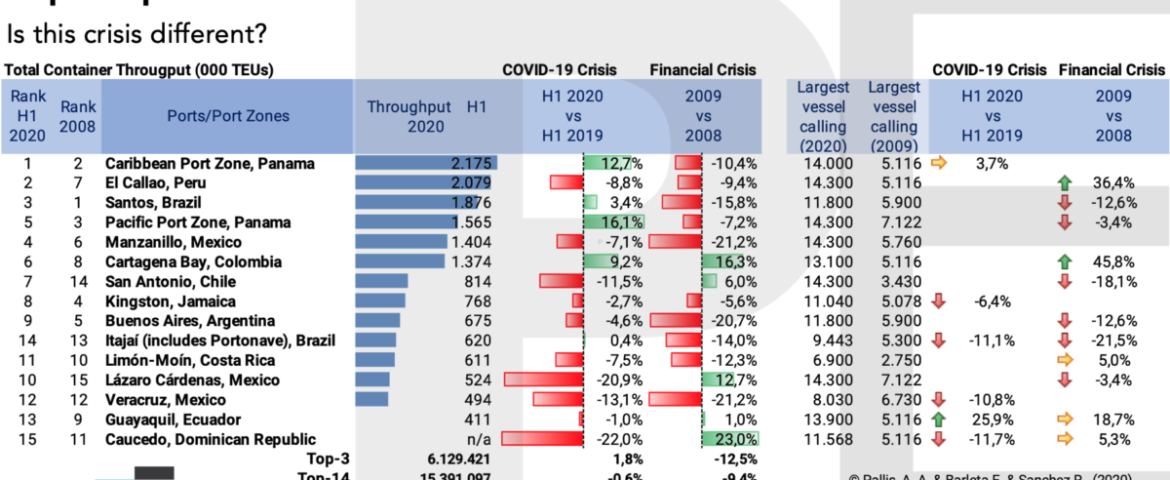
Our PortGraphic focuses on the top-15 container ports in Latin America and the Caribbean (LAC), revealing the impact of the COVID-19 pandemic and compares this impact with one of the previous major global crises, the financial tsunami that the world economy witnessed in 2008-09.

Since the early days of 2020, the world is experiencing a major crisis with a major impact on business, trade, and shipping. In Latin America alone, the United Nations Economic Commission for Latin America and the Caribbean (UN-ECLAC, 2020) affirmed that in terms of Gross Domestic Product (GDP) growth rate, in 2020 the region is suffering “the worst crisis since 1901”.

In the first half of 2020, the overall picture in the top-15 LAC container ports has sustained surprisingly positive. In terms of throughput, the top-3 LAC ports experienced a 1,8% growth and the top-15 ones experienced a minor decline of 0,8%.

At port level, the picture is mixed. The performance of both the Caribbean and Pacific zone of Panama have been remarkably positive, with Cartagena Colombia serving in H1 of 2020 9,2% more containers than it had done a year before. On the negative side, Caucado, along with the two biggest Mexican ports, Lazaro Cardenas and Veracruz, have been the ports that saw a major decline in the served throughput. San Antonio is the fourth port in the list were a double-digit percentage decline was observed when comparing H1 2020 with H1 2019.

Collecting data from a sample of ports representing 77.4% of the regional activity in 2019, UN-ECLAC observed a drop of the regional throughput by nearly 5.0% in the first half of 2020 against the same period in 2019 (ECLAC, 2020).

Conversely, the financial crisis of 2008-09 had a substantially different impact. In 2009 the top-3 ports and the top-15 had seen their throughput lowering by 12,3% and 9,4% respectively. During what which then termed as “the worst crisis since the 1930s”, LAC container ports moved nearly 32 million TEUs, the equivalent of 7% of the worldwide total, which was 13.7% less than in 2008. 

Different has also been the impact as regards the biggest vessel deployed in each of the major LAC ports. Contrary to what is reported in other parts of the world, in the case the impact of the COVID-19 crisis 2020 has implied fewer changes, and certainly less than the ones that were produced due to the financial crisis of 2008-09.

While recent publications have detailed how the COVID-19 pandemic has affected the global port systems (Notteboom and Pallis, 2020) and maritime supply chains (UNCTAD, 2020), the presented PortGraphic substantiates the need for exploring the full scale that the current global crisis is different from the previous one(s), and, second, the extent that this time regional variations might be present and more extensive.

References

ECLAC (2020). Movimiento portuario LAC. September 2020. United Nations Economic Commission for Latin America and the Caribbean (UN-ECLAC)

Notteboom T.E. & Pallis A.A. (2020). IAPH-WPSP Port Economic Impact Barometer Half Year Report: A survey-based analysis of the impact of COVID-19 on world ports in the period April to September 2020. International Association of Ports & Harbors.

UNCTAD (2020). COVID-10 and maritime transport: impact and responses. UNCTAD/DTL/TLB/NF/2020/1 (principal author: Thanos Pallis), Geneva: UNCTAD 

Authors

Thanos Pallis, University of the Aegean, Greece & Universidad de Los Andes, Colombia; Eliana Barleta, United Nations Economic Commission for Latin America and the Caribbean (UN-ECLAC); Ricardo Shanchez, United Nations Economic Commission for Latin America and the Caribbean (UN-ECLAC). All views expressed in the article are personal.
 

Next article Lloyd’s maritime academy certificate in port economics by P. de Langen
Previous article The UK Freeports initiative

Related Posts

Rhine-Scheldt delta port system Featured

Rhine-Scheldt delta port system

Commission unveils new EU Ports Strategy European Port Policy

Commission unveils new EU Ports Strategy

PortGraphic: Container port dynamics near Gibraltar Containers

PortGraphic: Container port dynamics near Gibraltar

Weekly Timeline
Mar 9th 4:35 PM
Featured

Rhine-Scheldt delta port system

Mar 6th 1:23 PM
Thematic Area

Commission unveils new EU Ports Strategy

Feb 18th 1:46 PM
Thematic Area

PortGraphic: Container port dynamics near Gibraltar

Feb 12th 12:25 PM
Featured

A metric of global maritime supply chain disruptions: The global supply chain stress index – maritime (GSCSI-M)

Jan 14th 12:56 PM
Noticeboard

Call for papers: Contemporary Maritime Economics: Transformations and Emerging Perspectives

Tweets by @PortEconomics
  • Containers
  • Cruise
  • EPP
  • Ports & COVID-19
  • Back to top
About PortEconomics

PortEconomics is a web-based initiative aiming to advance knowledge exchange on seaport studies. Established by maritime economists affiliated to academic institutions in Belgium, Greece and the Netherlands. It provides freely accessible research, education, information, and network-building material on critical issues of port economics, management and policies.

Additional Information
  • About
  • Login
  • Register
  • Edit Profile
  • Contact us
  • PortProfessionals
  • PortReport Series
  • Terms and Conditions
  • Cookie Policy
© PortEconomics 2025. All rights reserved.
Produced by PortEconomics
Manage Consent
To provide the best experiences, we use technologies like cookies to store and/or access device information. Consenting to these technologies will allow us to process data such as browsing behavior or unique IDs on this site. Not consenting or withdrawing consent, may adversely affect certain features and functions.
Functional Always active
The technical storage or access is strictly necessary for the legitimate purpose of enabling the use of a specific service explicitly requested by the subscriber or user, or for the sole purpose of carrying out the transmission of a communication over an electronic communications network.
Preferences
The technical storage or access is necessary for the legitimate purpose of storing preferences that are not requested by the subscriber or user.
Statistics
The technical storage or access that is used exclusively for statistical purposes. The technical storage or access that is used exclusively for anonymous statistical purposes. Without a subpoena, voluntary compliance on the part of your Internet Service Provider, or additional records from a third party, information stored or retrieved for this purpose alone cannot usually be used to identify you.
Marketing
The technical storage or access is required to create user profiles to send advertising, or to track the user on a website or across several websites for similar marketing purposes.
  • Manage options
  • Manage services
  • Manage {vendor_count} vendors
  • Read more about these purposes
View preferences
  • {title}
  • {title}
  • {title}