Featured

September 24th, 2018
Featured

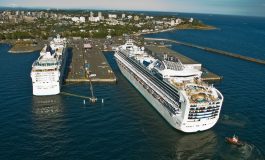
The US federal budgetary funds for construction and maintenance of a port are often linked to factors such as transportation cost saving and total tonnage, but seldom to the number of passenger served. In light of the popularity of passenger cruise ships, it is essential for the US Army Corps of Engineers (USACE) to explore and incorporate cruise ports in the scope of regional economic study so a standardized and objective assessment can be provided. However, while greater economic impacts are used for marketing purposes, the results...
September 18th, 2018
Featured

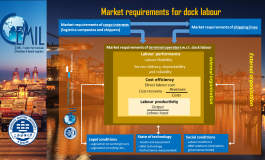
Seaports increasingly act as turntables in global supply chains and global production networks. Still, cargo handling remains a primary function of seaports. Dock workers have a key role to play in guaranteeing efficient and safe cargo handling activities at terminals. The organisation of dock work in seaports has received quite some attention in the past decade, not only in the port business but also in (European) policy circles. The academic journal ‘International Journal of Shipping and Transport Logistics' (IJSTL) recently...
September 17th, 2018
Featured

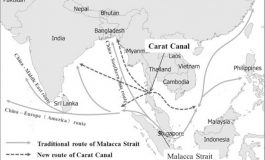
Under China’s Belt and Road (B&R) initiative, Carat Canal, a potential new channel of the Century Maritime Silk Road, will have a great impact on the shipping networks and the evolution of hub ports. A modified gravity prediction model with entropy maximizing principle is developed to calculate the changes in transshipment traffic. Taking account both customer preferences and spatial interaction, numerical experiments show that the opening of the Carat Canal shifts traffic volumes from the Malacca Strait, influences transshipment market...
September 12th, 2018
Featured

By Peter de Langen  July saw a major development in Antwerp’s port, with the announcement of the start of a stakeholder-inclusive process to expand container capacity. The process will start with a much smaller new dock than originally foreseen, coupled with a series of initiatives to expand capacity elsewhere in the port. Antwerp’s original plan to construct a major new tidal dock called ‘Saeftinghedok’ has been fiercely opposed for years by Doel 2020, a group of residents of the small village of Doel (and their...
September 6th, 2018
Featured

Which are the challenges & problems that cruise ports face? Do ‘regional’ perspectives exist? For instance, do sub-groups of European groups that face diverge challenges? Is there a North vs South dimension ? Are other parameters, such as governance (PA vs TO) and size that affect the challenges that cruise ports face? Those are the questions that PortEconomics members Thanos Pallis and Aimilia Papachristou discuss in a presentation delivered at the Jean Monnet Symposium on European Port Policy, which was held in Chios,...
September 4th, 2018
Featured

How the strategic planning of a liner alliance affects the development prospects of a container port? How the relations inside the alliance are reflected on port selection?  Shipping strategies and the rise of global liner alliances is the subject of PortEconomics member George Vaggelas' most recent port study. George has identified the linkages between an alliance and the ownership structure of a container port and the port's importance for the global trade, in order to better understand the evolvement of alliances strategies. His...
August 31st, 2018
Featured

Over the last two decades, terminal and stevedoring industries have been experiencing a profound reorganization process produced by the port reform worldwide, the progressive opening of formerly monopolistic (local) markets and a fast internationalization of the business. The new competitive environment determined a growing commitment of private investors in the (co-)funding and management of container port facilities, and reshaped major assumptions underlying investment and financial decisions in the industry. For exploiting open window...
August 29th, 2018
Featured

By Theo Notteboom Recently, it was announced that the project to deepen and widen the river Elbe, the nautical access to the port of Hamburg, got the green light. The river Elbe was deepened for the last time in 1999. The idea to improve the nautical conditions on the Elbe is on the table already for many years but project approval was stalled due to environmental issues and procedural complexities. Dredging projects are sensitive in political, port and community circles given the investments involved and the associated economic and...
August 23rd, 2018
Featured

On the complementary (rather than opposing) forces that interact to form a dynamic port governance system, in which the whole is greater than the assembled parts, was dedicated the presentation of PortEconomics member and co-director Theo Notteboom during the Jean Monnet Symposium on the future of the European Port Policy, that was held in Chios, Greece. Using a Chinese metaphor, Theo discusses the "Yin and Yang of seaport governance", and discussed them during  the Jean Monnet Round-Table: Towards a better Port Governance. Theo was...
August 21st, 2018
Featured

Aiming to effectively respond to calls for upgrading cruise terminals, while safeguarding public spending, port authorities started to seek the active involvement of third parties to finance, construct, operate, and/or commercially develop cruise facilities. Specialized cruise terminals replace multi-purpose or temporary docking facilities. New cruise terminals are built and existing ones are upsized and upgraded, imposing additional investments on the hosting ports. In their award winning paper (Winner of “Best Conference Paper”,...
Page 39 of 83...3738394041...