Featured

December 15th, 2018
Featured

By Peter de Langen The Organisation for Economic Co-operation and Development is at it again, this time with a report that argues alliances between container shipping companies may have negative impacts on users and society at large In short, according to the report, alliances have helped create overcapacity, made maritime transport services more uniform and contributed to lower service frequencies, fewer direct port-to-port connections, declining schedule reliability and longer waiting times. I have some concerns about the analysis,...
December 10th, 2018
Featured

Transport and logistics are expected to be in the future among the service sectors most impacted by Industry 4.0, due to the array of innovative applications that will be developed from emerging digital technologies related to both smart transports and “mobility as a service”. In this perspective, logistics centres constitute a fruitful research field for assessing the impact of incoming technologies on the business models of logistics companies operating in these centres, which play a pivotal role in international supply chains by...
December 5th, 2018
Featured

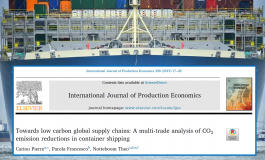
PortEconomics members Pierre Cariou, Francesco Parola and Theo Notteboom are the authors of a paper entitled "Towards low carbon global supply chains: A multi-trade analysis of CO2 emission reductions in container shipping". This study has just been published in the highly-ranked academic journal International Journal of Production Economics (volume 208, pages 17-28). The International Maritime Organization (IMO) has agreed in 2018 on a reduction of total greenhouse gas (GHG) emissions from international shipping. The study identifies the...
November 28th, 2018
Featured

PortEconomics member César Ducruet, and Justin Berli (Centre National de la Recherche Scientifique (CNRS), UMR 8504 Géographie-cités, Paris, France) and Mattia Bunel (Institut Géographique National, COGIT Saint-Mandé, France)- on their latest study, published at Networks and Spatial Economics latest issue, discuss main results in the light of network science, spatial science, and transport studies. Their study tackles the longstanding issue of intermodality head on. From ageomatics perspective, the authors model both maritime...
November 26th, 2018
Featured

PortEconomics members Mary Brooks and Patrick Verhoeven celebrate and contribute, along with other eminent guest essayists, in the history of the Review of Maritime Transport over the past 50 years, a publication that examines the past and future of maritime transport and its part in trade and development. Mary Brooks analyses the results of a survey exploring the opinion of some UNCTAD staff, selected UNCTAD collaborators and partners, as well as International Association of Maritime Economists members on how is the future of maritime...
November 21st, 2018
Featured

By Peter de Langen A study on better co-operation between terminals in Hong Kong by Hong Kong’s Hang Seng Management College has rightfully received industry attention of late. The study focuses on inter-terminal transfers (ITTs) between the five terminal operating companies in Hong Kong. The terminals charge for these ITTs, thus adding costs to already-high terminal rates in comparison with competing ports. Inter-terminal moves arise when a container arrives at, for example, terminal A, but needs to be moved to terminal B for the...
November 13th, 2018
Featured

The Belt and Road Programme (or Initiative) first initiated in 2013 constitutes the ultimate evolution of China's previous opening-up policies and spreads across over 65 nations located in Asia, Middle East, Europe and Africa, corresponding to the 63% of world population and 29% of global GDP, with an overall project value of about 900 billion USD (European Bank for Reconstruction and Development, 2018). BRI aims to make China a global nation and a recognized economic force worldwide, breaking down political and economic boundaries with...
November 9th, 2018
Featured

The European Sea Ports Association (ESPO) celebrates its 25 years with the publication of a Book of friends, gathering 30 memories and reflections of port people who are or have been instrumental in the life of the ESPO. Four PortEconomics members- Peter de Langen, Michael Dooms, Theo Notteboom, and Thanos Pallis- are among the contributors in ESPO's Liber Amicorum, bringing back memories and reflections of their extensive involvement in facilitating EPSO and its membership in advancing the interests of European ports. ESPO represents...
November 9th, 2018
Featured

By Theo Notteboom Belgian and Dutch container ports are located in the Rhine-Scheldt Delta, the largest container port region in Europe in volume terms. Dutch and Belgian ports together handled 25.8 million TEU in 2017 or 7.9% more than in 2016. The Belgian-Dutch port region recorded a year-on-year growth of 6.2% in Q1-Q3 2018, so growth remains strong. In 2017, 23.9% of the total European container port traffic was handled by Belgian and Dutch ports. With these figures, the Rhine-Scheldt Delta port region is the most important port...
November 6th, 2018
Featured

With the importance of corporate social responsibility being increasingly recognised, PortEconomics member Grace Wang co-authored along with Xiao Yi and Kevin Li (Chung-Ang University), a study that aims to help a cruise company identify social and environmental issues that present risks and opportunities, while taking into consideration the most concerning environmental issues to the external stakeholders. A Super-slack-based measure model, combined with the Malmquist productivity index, is applied to measure environmental efficiency in...
Page 37 of 83...3536373839...