Featured

April 18th, 2016
Featured

Whilst port infrastructure is crucial to the advancement of local and national economies, the fact remains that port infrastructure procurement, development and operations are costly both towards the capital expenditure needed to develop the assets, as well as the operating costs generated by running the assets. As a result, in tackling the burdens associated with public infrastructure development, several types of public-private mixing have arisen over the centuries. One type of cooperation that has gained a lot of attention in...
April 16th, 2016
Featured

Download PortReport No 1- Competition and complementarity between seaports and hinterlands for distribution activities PortEconomics celebrates the launching of PortReports, a PortEconomics series aiming to enrich business and academic insights related to the port sector. In PortReport No 1 -  authored by Jason Monios, Theo Notteboom, Gordon Wilmsmeier and Jean-Paul Rodrigue,  readers have the chance to identify types of distribution activities that ports are suitable locations for, and which of such activities are best suited to...
April 11th, 2016
Featured

 COMMENT: A quick way to get an understanding of the development potential of the ports industry in a country is to look at the throughput per capita, writes Peter de Langen. Eurostat publishes such data and the ‘usual suspects’ score highly. The Netherlands handles about 33 tons per year per capita and Belgium about 20, compared with the EU average of 7.3. However, Norway has the highest ratio - over 40 ton per capita - due to substantial import and export flows of liquid and dry bulk. Naturally, some countries have volume/capita...
April 4th, 2016
Featured

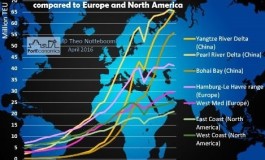
By Theo Notteboom The figure shows the evolution of container throughput in the three main container port regions in China (i.e. Yangtze River Delta, Pearly River Delta and the Bohai Rim). We compare these volume dynamics with some key port systems in North America and Europe: the port system along the North American West Coast including ports such as Seattle/Tacoma, Vancouver, LA, Long Beach and Oakland; East coast ports such as Norfolk, Charleston, New York/New Jersey, Baltimore, Savannah and Halifax; the Hamburg-Le Havre port range...
April 1st, 2016
Featured

PortEconomics associate member Mary Brooks was assigned by Transport Canada to evaluate port performance measures as part of the Canada Transportation Act review process. The Review was launched on June 25, 2014, and concluded on December 21, 2015 when it was submitted to the Minister of Transport. The Review looked forward 20 to 30 years to identify priorities and potential actions in transportation that will support Canada’s long-term economic well-being. The Canadian Government is currently reviewing the Report Collaboration with...
April 1st, 2016
Featured

The Port of Long Beach organised its 12th annual Pulse of the Ports Peak Season Forecast event, with keynote speakers revealing details on the prospects for growth in West Coast, US but also a number of perspectives on how port users and other stakeholders approach modern supply chains integration. PoLB released the video of the interesting meetings, chaired by Dr Noel Hacegaba - whereas the presentations at the event might be found here: Panelist's presentations (Source: Port of Long Beach)...
March 30th, 2016
Featured

A 5,62% increase of passenger movements comparing to 2014 was registered in Mediterranean cruise ports in 2015. The variation of cruise passenger movements in the second biggest cruise region of the world is positive when one relates the numbers with the one that had taken place at the beginning of the decade. In 2015 cruise ports in the Med and its adjoining seas hosted 10,7% more passenger movements than in 2010. MedCruise the association cruise ports in the Med and its adjoining seas revealed that a total of 27.206.023 cruise...
March 23rd, 2016
Featured

COMMENT: Last year was a year of differing fortunes for Belgium seaports, writes Peter de Langen. Volumes in Zeebrugge dropped by over 20%, from more than 2m teu to slightly over 1.5m teu, and PSA decided to close down its container terminal in the port. Meanwhile, volumes in Antwerp grew. Antwerp grew with roughly the amount of volumes that was lost in Zeebrugge, and here MSC and PSA are expanding and relocating their jointly operated terminal. Antwerp Port Authority is also pushing ahead with the development of a new dock, the so...
February 29th, 2016
Featured

The combination the three port products- 1. Transport hub, 2. Value-added logistics hub and 3. Industry, the strengthens of the overall port complex and the market segments for these three products were at the centre of PortEconomics co-director Peter de Langen presentation during the two-days workshop organised by the Arab Academy for Science, Technology and Maritime Transport, on 21-22 February in Jeddah, Saudi Arabia. Peter focused on the Golf Cooperation Countries  (GCC) transition challenges and analysed the quality for container...
February 26th, 2016
Featured

The quality in ports was in the centre of discussions during the two-days workshop organised by the Arab Academy for Science, Technology and Maritime Transport, on 21-22 February in Jeddah, Saudi Arabia. PortEconomics member George Vaggelas in his presentation discussed the quality attributes and the relations of quality of several operational aspects of a port. George analysed the reasons behind the importance of quality in ports and presented some well established quality processes and standards in the port industry and existing...
Page 57 of 83...5556575859...