Featured

June 30th, 2015
Featured

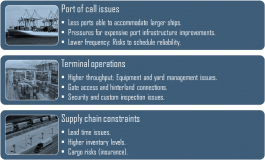
The OECD report on the effects on mega-ships provides valuable insights for all players in the port industry. Peter de Langen through his column "The Analyst" in Port Strategy focuses on an important flaw in the report: the suggestion that mega ships impose infrastructure costs on the public sector. Imposing means 'forcing (an unwelcome decision or ruling) on someone'. Peter explains why he fundamentally fails to see how mega-ships force port infrastructure investments on the public sector. Read the Analyst's comment on OECD report @...
June 21st, 2015
Featured

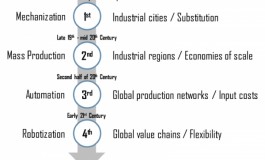
By Jean-Paul Rodrigue The current global manufacturing landscape is the outcome of successive waves of innovation and economic development and their geographical accumulation. Although the industrial revolution is often considered as a single ongoing event that began in the late 18th century, it can be better understood as four sequential paradigm shifts, or four industrial revolutions. Each revolution built upon the innovations of the prior revolution and lead to more advanced forms of manufacturing. PortEconomics member Jean-Paul...
June 18th, 2015
Featured

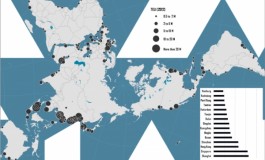
By Jean-Paul Rodrigue Container ports are reflective of the world's commercial geography particularly since they dominantly handle finished and intermediate goods. Commodities are becoming more prevalent, but still remain a niche market. The map below shows container volumes in 2012 for ports above half a million TEU. Surprisingly, there is no publicly available dataset covering the traffic of container ports around the world. Some regional or national trade groups publish figures, but this data is only for an area and tends to be...
June 13th, 2015
Featured

Theo Notteboom, PortEconomics co-director, gave a presentation on 'Short sea shipping in motion: the contribution of academic research in the period 1980 - 2015' at the closing plenary session of the GPRA conference (Global Port Research Alliance) held in Hong Kong on 21 and 22 May 2015. The early 1990s saw a growing interest in shortsea shipping (SSS) both in academic and policy circles. This was particularly visible in Europe where shortsea shipping and the later 'Motorways of the Sea concept' gained in importance on the transport policy...
June 11th, 2015
Featured

By Jean-Paul Rodrigue Maritime shipping, more than any other form of transportation, benefits from economies of scale since they have a direct impact on its operational costs. There has thus been a tendency to deploy larger ships, particularly in container shipping, to service high volume trade routes such as between Asia and Europe. PortEconomics member Jean-Paul Rodrigue comments: A common issue with the application of economies of scale is that the maritime shipping company is internalizing its benefits since they have a positive...
June 8th, 2015
Featured

More than 1.000 stakeholders and experts on the Blue economy gathered in Athens on 28th and 29th of May to discuss the future of Blue growth. PortEconomics member Michaël Dooms was invited in a high-level panel to share his views on the general theme "Ports: innovation hubs of the Blue Economy" along with Mr. Rémi Mayet from the European Commission, DG MOVE, Antonio Revedin, Director Strategic Planning and Development of the Venice Port Authority, Mr. Adam Banaszak, Member of the Committee of the Regions, and mr. Petros Kokkalis, Council...
June 1st, 2015
Featured

The OECD International Transport Forum (ITF) brings cruise and cruise ports at the centre of  discussions during the 2015 ITF/OECD Summit on "Transport, Tourism and Trade", with PortEconomics  co-director Thanos Pallis preparing the background discussion Paper to inform the high-level discussions that took place during the summit. Thanos contributes with a report covering the state of the art and growth potential of cruise shipping (Chapter 1), the characteristics, performance and competition of modern cruise ports (Chapter 2), and the...
May 31st, 2015
Featured

In Antwerp, the closure of the GM plant makes a huge site available for re-development, while in Rotterdam, one of the refineries (currently owned by Q8) is up for sale, writes Peter de Langen, co-director of PortEconomics in his viewpoint- published in his Port Strategy column as 'The Analyst'. For the latter, one scenario is a buyer will transform the refinery into a terminal for bulk cargoes. These cases from the two largest European ports show that both industrial and logistics facilities have a life-cycle. Similar closures of large...
May 31st, 2015
Featured

By Theo Notteboom Only 25 years ago, the container port system in mainland China was still in its infancy stage. During that time, Hong Kong acted as the only container gateway to China and Taiwanese ports Kaohsiung and Keelung benefited from Taiwan's economic success story in international trade. In May 1980, the Chinese government established the Shenzhen Special Economic Zone, the first special economic zone in China. By the late 1980s, mainland Chinese ports in the Pearl River Delta saw the first fruits of this opening up policy. Growth...
May 31st, 2015
Featured

With cruise activities in the Mediterranean and its adjoining seas increasing, the cruise world takes initiatives to handle the produced externalities, including the wastes produced on cruise ships. In recent times, cruise lines and ports have put a lot of efforts into reducing, selecting and managing generated wastes implementing the requirements of the international regulatory framework (MARPOL 73/78) as well as those imposed by the European legislation. Thanos Pallis and Aimilia Papachristou in their latest port study that was presented at...
Page 63 of 83...6162636465...