Featured

May 17th, 2015
Featured

PortEconomics co-director Theo Notteboom published a study commissioned by the Province of Antwerp on the employment and value added impact of the port of Antwerp on the municipalities in the Province of Antwerp and part of the Province of East Flanders in Belgium. The aim of the study was to analyse how much employment and value added in these municipalities is linked to the port. Also, the study presented figures on the municipal taxes linked to the employment effects of the port. The results show that in some villages and small cities close...
May 17th, 2015
Featured

PortEconomics co-director Theo Notteboom moderated the 'Port Lunch Flanders' event on 5 March 2015 in Antwerp. Some 150 participants joined the event which was organized by Management Producties. The conference theme was megatrends in seaports. A highlight of the day was a panel debate with Luc Arnouts (CCO, Port of Antwerp), Joachim Coens (CEO, Port of Zeebrugge) and Daan Schalk (Managing Director, Port of Ghent) on the challenges facing the three major Flemish ports in terms of megatrends in container shipping and the emergence of new...
May 17th, 2015
Featured

The latest study of PortEconomics co-director Theo Notteboom, porteconomics member Francesco Parola, associate member Giovanni Satta and Lara Penco (University of Genoa)- published in International Journal of Logistics Research and Application- provides a conceptual framework for evaluating the communication strategies a (landlord) port authority relies on in the management of its relevant stakeholders and the adoption of disclosure to critical issues. The theoretical arguments are supported by empirical evidences from the Port of...
May 11th, 2015
Featured

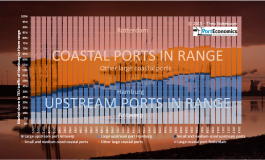
By Theo Notteboom One could think that the days for upstream ports are counted given a growing demand for a good nautical accessibility and a fast turnaround time for the ever larger container vessels. A closer look at Antwerp and Hamburg, two of the largest upstream container ports in the world, urges us to think again. In the past few decades the large upstream ports in the Hamburg-Le Havre range have gradually gained market share at the expense of large coastal ports. In the late 1970s, Antwerp on the river Scheldt and Hamburg on the...
May 9th, 2015
Featured

Maritime shipping and port operations are both facing economic and commercial changes in the post-recession era. From strategic changes in trade flows to the operational fickleness of supply chains, maritime shipping has shown a propensity to adapt by capturing new commercial opportunities. In an article based on his keynote speech delivered at TOC Container Supply Chain: Americas, in Cartagena, Colombia, PortEconomics member Jean-Paul Rodrigue discusses the new global principles for shipping and ports and conclude that this is "Not your...
May 7th, 2015
Featured

By Thanos Pallis The deployment of bigger cruise vessels along the globe are associated with the continuous increase of the average number cruise passengers that reach a cruise port via one call alone. The figures of the Mediterranean and the adjoining seas, the second biggest cruise region of the world provides a clear examble of this trend. During the last five years, the average number of passengers per cruise call increased by 13,3%, or from 1.657 to 1.878 passengers per call. The increase within the last decade is even more...
May 3rd, 2015
Featured

Last month, DP World bought the Maher terminal in Prince Rupert, with a 2014 throughput of a little over 600,000 teu for more than a half billion US dollar - just under $1,000 per teu handled, comments Peter de Langen at his "The Analyst" column in Port Strategy. Two aspects of this deal are interesting. First, the price seems to indicate huge confidence in growing volumes: the terminal is to be expanded to a capacity of about 1.35m teu, with studies on the feasibility of a further expansion to about 2.5m teu. Second, the fact that the...
April 30th, 2015
Featured

PortEconomics co-director Peter de Langen led an initiative to develop a cooperation platform to promote industry oriented research in the port of Rotterdam. Five founding partners, Port of Rotterdam Authority, the business community, Erasmus University Rotterdam, Delft University of Technology and the city of Rotterdam have committed significant resources to this initiative (see www.smart-port.nl). This initiative fits in a broader challenge: ports, as strong clusters of economic activities, have- whether they are aware of this or not- an...
April 27th, 2015
Featured

Current heterogeneity in EU port regulation is having an impact on the competitiveness of ports. Port Authorities have to take into account a wide range of goals in order to manage the interactions with private operators responsible for port activities. Thus, some trade-offs emerge, as in some cases a revenue stream or a strategic objective for the Port Authority may imply a cost for the concessionaire. PortEconomics member Francesco Parola, along with Claudio Ferrari (University of Genova) and Alessio Tei (University of Genova), study how...
April 24th, 2015
Featured

The variety of pricing structures is remarkable. For instance, a substantial amount of charges are paid by shippers in South Africa, contrary to most other countries. In Singapore, virtually all revenues come from port dues and virtually none from land rents in ports or charges to shippers. The opposite is true in many US and Canadian ports; here, the majority of revenues are from land lease agreements. This suggests that 'history' may be an important factor. How can pricing structures in ports be best explained? are they based on a specific...
Page 64 of 83...6263646566...