


Featured
Featured

Featured
Cruise ports: passengers per cruise call
By Thanos Pallis The deployment of bigger cruise vessels along the globe are associated with the continuous increase of the average number cruise passengers that reach a cruise port via one call alone. The figures of the Mediterranean and the adjoining seas, the second biggest cruise region of the world provides a clear examble of this trend. During the last five years, the average number of passengers per cruise call increased by 13,3%, or from 1.657 to 1.878 passengers per call. The increase within the last decade is even more...
Featured
The Analyst: belief in canadian container prospects
Last month, DP World bought the Maher terminal in Prince Rupert, with a 2014 throughput of a little over 600,000 teu for more than a half billion US dollar - just under $1,000 per teu handled, comments Peter de Langen at his "The Analyst" column in Port Strategy. Two aspects of this deal are interesting. First, the price seems to indicate huge confidence in growing volumes: the terminal is to be expanded to a capacity of about 1.35m teu, with studies on the feasibility of a further expansion to about 2.5m teu. Second, the fact that the...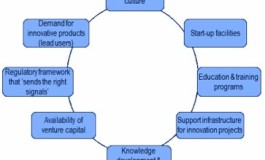
Featured
Ports innovation ecosystem
PortEconomics co-director Peter de Langen led an initiative to develop a cooperation platform to promote industry oriented research in the port of Rotterdam. Five founding partners, Port of Rotterdam Authority, the business community, Erasmus University Rotterdam, Delft University of Technology and the city of Rotterdam have committed significant resources to this initiative (see www.smart-port.nl). This initiative fits in a broader challenge: ports, as strong clusters of economic activities, have- whether they are aware of this or not- an...
Featured
Governance models and port concessions in Europe: commonalities, critical issues, policy perspectives
Current heterogeneity in EU port regulation is having an impact on the competitiveness of ports. Port Authorities have to take into account a wide range of goals in order to manage the interactions with private operators responsible for port activities. Thus, some trade-offs emerge, as in some cases a revenue stream or a strategic objective for the Port Authority may imply a cost for the concessionaire. PortEconomics member Francesco Parola, along with Claudio Ferrari (University of Genova) and Alessio Tei (University of Genova), study how...
Featured
The Analyst: pricing of transhipment by port authorities
The variety of pricing structures is remarkable. For instance, a substantial amount of charges are paid by shippers in South Africa, contrary to most other countries. In Singapore, virtually all revenues come from port dues and virtually none from land rents in ports or charges to shippers. The opposite is true in many US and Canadian ports; here, the majority of revenues are from land lease agreements. This suggests that 'history' may be an important factor. How can pricing structures in ports be best explained? are they based on a specific...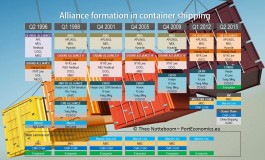
Featured
Alliances in container shipping: searching for the best dance partners
By Theo Notteboom Operational co-operation between container shipping companies comes in many forms ranging from slot-chartering and vessel-sharing agreements to multi-trade strategic alliances. The first strategic alliances between shipping lines date back to the mid-1990s, a period that coincided with the introduction of the first post-Panamax containers vessels on the Europe-Far East trade. In 1997, about 70% of the services on the main East-West trades were supplied by the four main strategic alliances. Today, four large alliances are...
Featured
The economics of port authority reform: a framework for ex-post evaluation
The activities of a port authority form but one of several factors that can contribute to the competitiveness of a port. A port authority can increase its contribution by optimising the various functions it performs in a facilitating and entrepreneurial manner. Port authority reform matters in that it must set the right governance framework for port authorities to achieve their full potential contribution to the competitiveness of their ports. The objective of this study of PortEconomics associate member Patrick Verhoeven along with Eddy...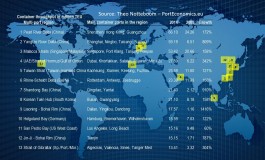
Featured
Top 13 container port regions in the world: the rise of China
By Theo Notteboom Container port rankings look at individual ports. Following such an approach Shanghai is the largest container port in the world (35.28 million TEU in 2014) followed by Singapore (33.87 million TEU). Such rankings can be a bit misleading as regions with several medium-sized container ports might seem less important than regions with only one large load centre. When grouping seaports together in multiple-port regions we get a better picture of the container port handling hotspots in the world. The chart provides an...
Featured