Thematic Area

October 1st, 2020
Thematic Area

Economic shocks test the resilience and adaptability of the maritime supply chains, with every new crisis triggering different ramifications. The seminar will focus on the temporal and spatial sequences of the supply and demand shocks of COVID-19 on shipping, ports, and related supply chains. The COVID-19 crisis and the distributions and adaptability of maritime transport supply chains is the theme of the Supply Chain and Technology Seminar (webinar) of the Universidad De Los Andes Facultad de Administracion to be held on November...
September 22nd, 2020
Thematic Area

The main implications of the pandemic on global logistics with a specific focus on container ports and shipping lines is the theme of a joint contribution by Theo Notteboom, Thanos Pallis and Jean-Paul Rodrigue in the 100th issue of Port Technology International. The COVID-19 pandemic led to the second global crisis since the 2009 financial crisis, which resulted in a recession in all OECD countries and most emerging economies. It fundamentally challenged the direction of future trade flows and trade arrangements. The stability...
September 20th, 2020
Thematic Area

IAPH published the half-year report of its COVID-19 Port Economic Impact Barometer authored by PortEconomics members Theo Notteboom and Thanos Pallis.  On the week following the six month anniversary of the World Health Organization (WHO) announcement of COVID-19 as a global pandemic, the International Association of Ports and Harbors (IAPH) has published a comprehensive report summarising all findings from its twelve surveys of global ports since early April, including its most recent survey to ports in week 36. The COVID-19...
September 15th, 2020
Thematic Area

by Cesar Ducreat Our recurrent focus on the present and future of containerization makes us forget older revolutions such as the sail to steam transition in the late nineteenth and early twentieth centuries. Are such revolutions comparable with each other? Do they obey similar mechanisms, in terms of spatio-temporal diffusion, port competition, and hierarchical dynamics, shipping network reorganization? Research on this is only at its eve. Our most recent research provides preliminary results using the archival corpus of the...
September 10th, 2020
Thematic Area

Cruise shipping supply chains have unique characteristics where product and service providers accommodate stringent requirements related to the nature of the cruise product. Since cruise ships are floating resorts that must be resupplied during their short port rotations, they require customized procurement practices. The sustainability of such practices is investigated by PortEconomics members Jean-Paul Rodrigue and Grace Wang, through the lenses of contract dynamics among actors, including sourcing patterns, consumption patterns, pricing,...
September 1st, 2020
Thematic Area

In a port study on port management and governance, that is published as an editorial in the scholarly journal Maritime Economics and Logistics (MEL), PortEconomics co-director Theo Notteboom and Hercules Haralambides provide a critical assessment of some of the key issues and themes in port governance research, attempting at the same time, to propose new avenues for further port research in a post-COVID-19 era. As the authors state, "Port management governance is continuously challenged to adapt to a changing port...
September 1st, 2020
Thematic Area

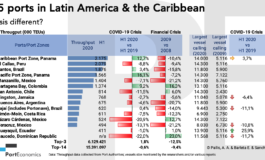
By Ricardo J. Sánchez & Eliana P. Barleta The throughput of containerized cargo in Latin American and Caribbean ports remained static in 2019, registering an increase of only 0.04% compared to the previous year, according to the Port Report launched today by ECLAC. The sample covers 36 countries and territories, with a total of 125 ports and port areas in the region. The total volume transferred in 2019 exceeded 54.2 million TEU, representing 6.5% of the total global throughput, The total volume transferred in 2019 exceeded 54.2...
August 20th, 2020
Thematic Area

The latest port study of PortEconomics members Francesco Parola and Giovanni Satta, co-authored by Nicoletta Buratti and Francesco Vitellaro (University of Genoa) investigates how the adoption of emerging digital technologies can provide valuable business opportunities for logistics centres in maritime supply chains. For this purpose, a systematic literature review (SLR) of prior academic studies addressing this topic is performed. The review unveils the current lack of a comprehensive framework to assess the impact of digital technologies...
August 7th, 2020
Thematic Area

While the Coronavirus emerged in China in December 2019, its impact on European ports only started to be visible in March 2020 . The table shows the container throughput for H1 2020 in the top 15 container ports in Europe. Note that the figures for Hamburg and Gioia Tauro relate to Q1 2020 (H1 2020 figures are expected to be lower), while the figures for Gdansk and Bremerhaven only cover the first five months of 2020. Antwerp is the only large gateway port in Europe which was able to reach a volume level comparable to last year The port of...
August 6th, 2020
Thematic Area

The port industry as an energy-intensive sector, generating negative externalities and environmental impacts in several areas, e.g., air emissions, water emissions, etc. (Bailey and Solomon, 2004; Dinwoodie el at., 2012). magnitude of highly impacting business processes/activities embedded in port spaces variety of economic actors located within/around port boundaries. These arguments are urging for the adoption of innovative green strategies for the reduction of energy consumptions, making energy management more efficient (Acciaro, 2015). The...
Page 19 of 58...1718192021...