Viewpoints

February 28th, 2019
Viewpoints

By Peter de Langen Lately, there has been much talk about the entry of new disruptors into ocean shipping, with Amazon most frequently referenced When ‘entry’ is understood as providing ocean freight services, this is now happening: Amazon is already handling shipment of goods by ocean for Chinese merchants that sell on Amazon’s site. In addition, Amazon has entered the market for delivery services for businesses, competing with the like of UPS and FedEx. It has not gone unnoted that Amazon owns and leases more than 40 cargo...
February 19th, 2019
Viewpoints

Automation is bringing a series of paradoxes to the shipping industry. Since maritime shipping is in the derived demand business, it is misleading to assume that automation does not affect the demand for shipping as well. Although automation is mostly considered by the industry at the port terminal level, it also takes place across entire supply chains, a process associated with the fourth industrial revolution (manufacturing 4.0/4IR). The impacts of automation may thus be more significant on the activities that drive port volumes, such as...
February 7th, 2019
Viewpoints

Genova - In the Port 4.0, that runs towards the automation of as many activities as possible, the work on the dock is not destined to become extinct, but rather to evolve. A path that however can not pass only through the transformation of processes, but rather from the training of workers. George Vaggelas, professor at the University of the Aegean and a partner of P & S Advisory, a consulting firm for some big port terminals, such as COSCO and DP World, is convinced of this. Which are, in short, the skills that the docker of the future...
February 4th, 2019
Viewpoints

By Peter de Langen The recent announcement of a new container storage system, which according to the developers can triple terminal capacity, is interesting news. Container storage methods have changed little, if at all, over the last decades. But now a German industrial engineering group — an ‘outsider’ with no prior expertise in container storage systems — and DP World have jointly developed a system, similar to those in automated warehouses, to store and retrieve containers up to 11 stacks high. The value of such a...
December 15th, 2018
Viewpoints

By Peter de Langen The Organisation for Economic Co-operation and Development is at it again, this time with a report that argues alliances between container shipping companies may have negative impacts on users and society at large In short, according to the report, alliances have helped create overcapacity, made maritime transport services more uniform and contributed to lower service frequencies, fewer direct port-to-port connections, declining schedule reliability and longer waiting times. I have some concerns about the analysis,...
November 21st, 2018
Viewpoints

By Peter de Langen A study on better co-operation between terminals in Hong Kong by Hong Kong’s Hang Seng Management College has rightfully received industry attention of late. The study focuses on inter-terminal transfers (ITTs) between the five terminal operating companies in Hong Kong. The terminals charge for these ITTs, thus adding costs to already-high terminal rates in comparison with competing ports. Inter-terminal moves arise when a container arrives at, for example, terminal A, but needs to be moved to terminal B for the...
October 29th, 2018
Viewpoints

By Mary Brooks First published @theconversation.com In March, Transport Minister Marc Garneau announced the launch of the Ports Modernization Review, a series of consultations, round-tables and meetings re-examining Canada’s port authority system. Recent studies of port governance have shown that there is no one right governance model for ports. Last year, my colleagues and I conducted a review of port reform around the globe. We concluded that there are many models that deliver the best port services in terms of trade efficiency...
October 24th, 2018
Viewpoints

Almost from its inception, there has been a clear upward trend in the disruptive force of the container during its use. However, a relative decrease in container movement has been seen in recent years, the explanation of which goes beyond disturbances in the world economy. PortEconomics member Ricardo J. Sánchez along with Eliana Barleta, note that the inter-annual change in throughput with respect to changes in GDP is declining. To understand this phenomenon, Ricardo and Eliana have examined variations in containerization, notably factors...
October 18th, 2018
Viewpoints

The innovation ecosystem as an undervalued driver of port competitiveness presented PortEconomics co-director Peter de Langen during the 107th AAPA Convention hosted by port and the city of Valparaíso, Chile in 7-10 October 2018. Peter gave emphasis in the at the importance of the ecosystems services and the industries that can be attracted to the port ecosystem, while he presented the integrated approach to innovation performance of the port complex via a graphic. Download Peter's presentation and find out more!...
October 8th, 2018
Viewpoints

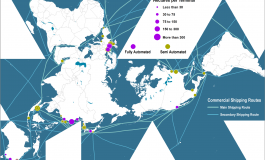
By Jean-Paul Rodrigue Automation is an emerging trend in port terminal development, but taking place at different scale, pace and locations. There are various degrees of automation and in many ways automation is present in a large number of terminals depending how it is defined and if it focuses on infrastructure (e.g. stacking cranes) or information systems (e.g. yard management). The most common definition classifies terminals as fully or semi automated, which is a rather partial one. For instance, a fully automated terminals is...
Page 10 of 29...89101112...