Viewpoints

July 1st, 2016
Viewpoints

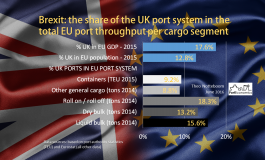
UK ports handle about 14% of the total EU port throughput while the country's share in total EU population and EU GDP amounts to 12.8% and 17.6% respectively. UK ports are particularly important in the Ro-Ro business as a result of the many cross-channel ferries, services to Ireland and within the UK, and Ro-Ro lines to the rest of Europe. The UK's share in liquid bulk cargo amounts to 15.6%. Just over 9% of total EU container throughput passes via UK ports. The announced Brexit will thus have a very visible impact on EU port throughput...
June 22nd, 2016
Viewpoints

By Jean-Paul Rodrigue and Theo Notteboom Shifting Rationale The interoceanic canals of the global shipping network are undergoing a major upgrading. One year after the expansion of the Suez Canal aimed at facilitating two-way vessel traffic, we are witnessing the opening of a new and larger set of locks at the Panama Canal. The new locks are designed to allow the transfer of ships with a length of up to 366m, a width of 49m and a draft of 15.2m. These New Panamax dimensions are 25% longer, 52% wider and support a draft which is 26% deeper...
June 19th, 2016
Viewpoints

"An effective management model to bring down costs can be gleaned from the airport industry". That is the central argument of a viewpoint article by Peter de Langen and Periklis Saragiotis - published at the blogs page of Brookings Insitute, and PortEconomics.eu. The viewpoint: Why ports should be managed like airports Sea transport is the cheapest form of transport and more than 75 percent of international merchandise is carried by vessels. Yet, costs are still substantially higher than they should be. This is especially evident in...
June 2nd, 2016
Viewpoints

With total throughput 6.36 million tonnes of dry bulk cargo, 3.98 million TEUs, 28.23 million coastal passengers and 2.07 cruise passengers in 2014, Greek ports are important actors in local, national and regional level. In 2014, their turnover exceeded the €326 million. GREPORT 2016, the Report on Greek Ports  by PortEconomics members Thanos Pallis and George Vaggelas is the first comprehensive record and analysis of the developments of the Greek port industry over the last decade. The port study, published by Port &...
June 1st, 2016
Viewpoints

By Theo Notteboom Alliances are about operational vessel-sharing co-operation between container shipping companies on multiple trade routes (mostly east-west). The first strategic alliances between shipping lines date back to the mid-1990s, a period that coincided with the introduction of the first post-Panamax containers vessels on the Europe-Far East trade. The alliance partnerships evolved as a result of mergers and acquisitions (e.g. merger between P&OCL and Nedlloyd and the take-overs by P&O Nedlloyd and SeaLand by...
May 22nd, 2016
Viewpoints

COMMENT: Port reform processes gradually lead to a port industry where port authorities remain under government ownership, but have autonomy, are financially self-sustaining and operate as port development companies, writes Peter de Langen. In this framework, these port authorities are, like many airport companies, state owned enterprises, or SOEs. The good news is that there is an increasing understanding of how and how not to manage SOEs. The bad news is that some of these insights are not being applied to the ports industry. Take the...
May 20th, 2016
Viewpoints

The movement of cargo in containers in Latin American and Caribbean ports grew 1.7% during 2015, according to figures unveiled in ECLAC’s new edition of its ranking of container port throughput, published in its Maritime Profile. These figures confirm two trends observed during the last years in the region: the slowdown of foreign trade shown by container terminals and great heterogeneity of the growth rates inside the region. Regional average of 1.7% container throughput growth, although still higher than the rate recorded in 2014...
May 3rd, 2016
Viewpoints

By Peter de Langen and Jonas Mendes Constante After many years advising companies from different sectors about creating and executing their strategic plans, we have witnessed both good and bad decisions - not necessarily in equal order. Here, we outline the five most common mistakes that port authorities and terminals companies make. First up, it is important to remember that the strategic plan is a document, not a process. A strategic plan can only create results if its goals are widely shared and incorporated by all departments, and if...
April 30th, 2016
Viewpoints

Since the early-2000s, given the increasing profitability of the container port business, a number of financial investors were stimulated to both reach new market segments and enter the industry as investors. As additional financial resources have been increasingly requested from the sector to fuel greenfield mega-projects, M&A activity and the accelerated foreign expansion of international terminal operators (ITOs), financial investors increased have their effort by providing financial and technical support to both shipping...
April 18th, 2016
Viewpoints

Whilst port infrastructure is crucial to the advancement of local and national economies, the fact remains that port infrastructure procurement, development and operations are costly both towards the capital expenditure needed to develop the assets, as well as the operating costs generated by running the assets. As a result, in tackling the burdens associated with public infrastructure development, several types of public-private mixing have arisen over the centuries. One type of cooperation that has gained a lot of attention in...
Page 17 of 29...1516171819...