


• Home
  • About
    • Members
    • Associate Members
    • Former members
  • Thematic Areas
    • Containers
    • Cruise
    • European Port Policy
    • Ports & COVID-19
  • PortStudies
  • Presentations
  • Noticeboard
  • Viewpoints
  • PortLibrary
  • PortReport
PortEconomics
  • February 21st, 2026
PortEconomics
  • Home
  • About
    • Members
    • Associate Members
    • Former members
  • Thematic Areas
    • Containers
    • Cruise
    • European Port Policy
    • Ports & COVID-19
  • PortStudies
    A metric of global maritime supply chain disruptions: The global supply chain stress index - maritime (GSCSI-M)

    A metric of global maritime supply chain disruptions: The global supply chain stress index - maritime (GSCSI-M)

    ESG disclosure as a proxy of port corporate communication and sustainable management strategy: An LDA approach

    ESG disclosure as a proxy of port corporate communication and sustainable management strategy: An LDA approach

    From coal exports to green steel production? The role of circular economy precincts for sustainable port diversification

    From coal exports to green steel production? The role of circular economy precincts for sustainable port diversification

    Maritime transport in net zero

    Maritime transport in net zero

    Onboard carbon capture, utilisation and storage (CCUS) supply chain optimisation: an application to vessels active in the offshore wind industry

    Onboard carbon capture, utilisation and storage (CCUS) supply chain optimisation: an application to vessels active in the offshore wind industry

  • Presentations
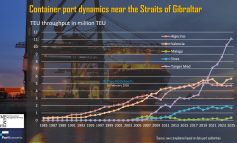
    PortGraphic: Container port dynamics near Gibraltar

    PortGraphic: Container port dynamics near Gibraltar

    Top-10 PortReads in 2025

    Top-10 PortReads in 2025

    Port reform: World Bank publishes the third edition of its port reform toolkit

    Port reform: World Bank publishes the third edition of its port reform toolkit

    When will we admit that maritime transport will not be decarbonised by 2050?

    When will we admit that maritime transport will not be decarbonised by 2050?

    Digital technologies for efficient and resilient sea-land logistics

    Digital technologies for efficient and resilient sea-land logistics

  • Noticeboard
    Call for papers: Contemporary Maritime Economics: Transformations and Emerging Perspectives

    Call for papers: Contemporary Maritime Economics: Transformations and Emerging Perspectives

    ECONSHIP2026: Call for papers

    ECONSHIP2026: Call for papers

    Call for papers: 1st Florence Maritime Regulation Conference

    Call for papers: 1st Florence Maritime Regulation Conference

    PortEconomics co-director appointed Senior Scientific Advisor to the Florence School of Regulation

    PortEconomics co-director appointed Senior Scientific Advisor to the Florence School of Regulation

    Jean Monnet Chair in European Port Policy

    Jean Monnet Chair in European Port Policy

  • Viewpoints
    PortGraphic: Top-15 EU container ports in Q3 2025

    PortGraphic: Top-15 EU container ports in Q3 2025

    Maritime transport in net zero

    Maritime transport in net zero

    Portgraphic: Top-15 EU container ports in H1 2025

    Portgraphic: Top-15 EU container ports in H1 2025

    Portgraphic: fleet capacity (owned/chartered) of container shipping lines

    Portgraphic: fleet capacity (owned/chartered) of container shipping lines

    In a tight spot: American ports in global supply chains

    In a tight spot: American ports in global supply chains

  • PortLibrary
  • PortReport
Climate change adaptation in the port industry: a complex of lingering research gaps and uncertaintiesFeatured

Climate change adaptation in the port industry: a complex of lingering research gaps and uncertainties

October 19th, 2020 Featured, PortStudies, Thematic Area

READ ALSO

From coal exports to green steel production? The role of circular economy precincts for sustainable port diversification
Stakeholders’ attitudes toward container terminal automation
Optimizing Asia–Europe container network: The Suez Canal and Cape of Good Hope routes in a changing world
PortGraphic: Container port dynamics near Gibraltar

Despite a rise in global attention to port managers’ actions on climate change, hitherto, they still face considerable challenges in reaching collective agreements on proactive policies and hands-on actions. Considering the influence of port as the middle- man of global trade and development, the study of PortEconomics member Adolf Ng co-authored by Roozbeh Panahi and Jiayi Pang (University of Manitoba, Canada) undertakes semantic and geographic coverage analysis of major articles on port climate change adaptation to shed light on the evolution of research over last fifteen years. With semantic analyses, the authors extract material words and expressions of identified articles, based on their title and keywords, and discuss when they have been taken into consideration and how they have been jointly studied. Also, the analysis shows the formation and expansion of research communities.

Finally, geographic coverage of research and geographic distribution of researchers explain to what extent this subject has been explored and knowledge has been disseminated around the globe. The study hereby suggests that future research should claim adaptation leadership by a quick paradigm shift, to support timely decisions. It is time to move ahead, focus more on adaptation actions and approaches to bridge adaptation gaps.

The authors’ version of the port study, published at the 95th voloume of Transport Policy can be downloaded here.
Next article Latest WPSP COVID19 Barometer Report: ports hold firm on environmental sustainability investments
Previous article The geography of maritime ranges: interfacing global maritime shipping networks with hinterlands

Adolf K.Y. Ng

Adolf K.Y. Ng is Professor of Transport and Supply Chain Management at the Asper School of Business of the University of Manitoba (Canada) and the Director of the University of Manitoba Transport Institute (UMTI) (Canada). He obtained his DPhil from University of Oxford (UK), and worked as a faculty member at the Hong Kong Polytechnic University (China) and Erasmus University Rotterdam, (Netherlands). He primary research interests include maritime management, transport geography, climate change, transport infrastructure planning and management, and global supply chains. He has (co-)authored three scholarly books, more than 40 papers in leading scholarly journals, and other forms of publications. He has received numerous prestigious accolades around the world. Notable examples include Fulbright Scholar Program (USA), Endeavour Research Fellowship (Australia), Universités Parisiennes Fellowship (France), Rh Award for Outstanding Contributions to Scholarship and Research in Interdisciplinary Studies (Canada), Associates’ Achievement Award for Outstanding Business Research (Canada), Eagle Prize for Outstanding Young Scholar in Maritime Research (International Association of Maritime Economists) (IAME), and several Best Paper Awards by various international transport, logistics, and supply chain conferences. With such expertise, he has provided strategic advice to major intergovernmental organizations, such as the United Nations (UN), European Commission (EC) and the African Development Bank (AFDB). Currently, he is a council member of IAME, Associate Editor of Maritime Policy & Management, Co-Editor of Journal of Transport Literature, Associate Editor of The Maritime Economist, and an editorial board member of reputable geography, transport, and logistics journals.

Related Posts

PortGraphic: Container port dynamics near Gibraltar Containers

PortGraphic: Container port dynamics near Gibraltar

A metric of global maritime supply chain disruptions: The global supply chain stress index - maritime (GSCSI-M) Featured

A metric of global maritime supply chain disruptions: The global supply chain stress index - maritime (GSCSI-M)

PortGraphic: Top-15 EU container ports in Q3 2025 Containers

PortGraphic: Top-15 EU container ports in Q3 2025

Weekly Timeline
Feb 18th 1:46 PM
Thematic Area

PortGraphic: Container port dynamics near Gibraltar

Feb 12th 12:25 PM
Featured

A metric of global maritime supply chain disruptions: The global supply chain stress index – maritime (GSCSI-M)

Jan 14th 12:56 PM
Noticeboard

Call for papers: Contemporary Maritime Economics: Transformations and Emerging Perspectives

Jan 4th 12:46 PM
Thematic Area

PortGraphic: Top-15 EU container ports in Q3 2025

Dec 16th 1:12 PM
Featured

Top-10 PortReads in 2025

Tweets by @PortEconomics
  • Containers
  • Cruise
  • EPP
  • Ports & COVID-19
  • Back to top
About PortEconomics

PortEconomics is a web-based initiative aiming to advance knowledge exchange on seaport studies. Established by maritime economists affiliated to academic institutions in Belgium, Greece and the Netherlands. It provides freely accessible research, education, information, and network-building material on critical issues of port economics, management and policies.

Additional Information
  • About
  • Login
  • Register
  • Edit Profile
  • Contact us
  • PortProfessionals
  • PortReport Series
  • Terms and Conditions
  • Cookie Policy
© PortEconomics 2025. All rights reserved.
Produced by PortEconomics
Manage Consent
To provide the best experiences, we use technologies like cookies to store and/or access device information. Consenting to these technologies will allow us to process data such as browsing behavior or unique IDs on this site. Not consenting or withdrawing consent, may adversely affect certain features and functions.
Functional Always active
The technical storage or access is strictly necessary for the legitimate purpose of enabling the use of a specific service explicitly requested by the subscriber or user, or for the sole purpose of carrying out the transmission of a communication over an electronic communications network.
Preferences
The technical storage or access is necessary for the legitimate purpose of storing preferences that are not requested by the subscriber or user.
Statistics
The technical storage or access that is used exclusively for statistical purposes. The technical storage or access that is used exclusively for anonymous statistical purposes. Without a subpoena, voluntary compliance on the part of your Internet Service Provider, or additional records from a third party, information stored or retrieved for this purpose alone cannot usually be used to identify you.
Marketing
The technical storage or access is required to create user profiles to send advertising, or to track the user on a website or across several websites for similar marketing purposes.
  • Manage options
  • Manage services
  • Manage {vendor_count} vendors
  • Read more about these purposes
View preferences
  • {title}
  • {title}
  • {title}