Featured

July 22nd, 2020
Featured

Participating in a virtual conference on decarbonising transport in an unprecedented global crisis with focus on Argentina and Latin America, PortEconomics member Jean-Paul Rodrigue gave a presentation on the challenges that trade and supply chains are facing and approached the issue from the maritime transport perspective. The virtual conference, organised by the International Transports Forum of OECD, discusses in a nine sessions between 7 and 30 July duration, how can transport decarbonisation policies promote low-carbon economic growth...
July 20th, 2020
Featured

Since the beginning of the ’80s, the cruise market has been experiencing a relentless growth, with two-digit growth rates (Pallis et al., 2018). In recent years, the number of global cruise passengers has almost doubled from 17.8 million in 2009 to about 30 million in 2019 (CLIA, 2020). These market trends have been accompanied by an increasing interest from both the civil society and heterogeneous groups of stakeholders towards the assessment of the various impacts generated by this business in terms of positive and negative externalities...
July 9th, 2020
Featured

In the latest port study of PortEconomics member César Ducruet along with Laure Rousset (Ecole Nationale Supérieure, France) discusses the effect of local exogenous shocks on seaports and maritime networks and is assessed throughout three case-studies. The Hanshin-Awaji earthquake, the 9/11 World Trade Center attack and hurricane Katrina triggered a shock on Kobe, New York and New Orleans respectively and led to temporary port failures. A global database on vessel movements is computed to gauge the intensity, duration and scope of these...
July 3rd, 2020
Featured

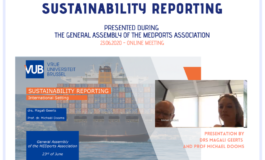
Invited by the MEDports Association and its 5th General Assembly, PortEconomics member Michael Dooms along with Magali Geerts, presented their latest study on Port Sustainability which was supported by the Sustainability Committee of the MEDports Association. Michael's and Magali's port study offers a multidimensional approach of the concept of sustainability reporting based on a global survey yielding 97 complete and valid answers of PMBs. A binomial logistic regression has been conducted to identify those internal determinants...
June 30th, 2020
Featured

Colombia is the second most biodiverse country in the world and borders on the Pacific Ocean and Caribbean Sea. The country´s marine-coastal zones display a great variety of strategic ecosystems coral reefs, mangroves, sea grass areas, and beaches, among others. These landscapes and ecosystem present a key role in Colombia´s exposure to climate change; as they provide protection against sea-level  change, climate regulation and climate change hydrology, and erosion control (UNDP 2014). However, these ecosystems have been subject of...
June 22nd, 2020
Featured

Download PortReport No 5 - Transparency in governance: seaport practices PortReport No 5 explores the levels and standards of transparency in the governance of ports. Key actors in port governance, such as government departments involved in port policy-making, port authorities, and port regulators need to be transparent about their behavior, policies, and practices as a way of enhancing economic performance and accountability to their stakeholders, particularly the community that hosts the port. The report explores the availability of...
June 22nd, 2020
Featured

IAPH-WPSP Port Economic Impact Barometer for Week 25 reports on reduced cargo volumes, intensified competition in inland transport modes, and passenger and ro-pax services restarting with limited capacity In its ninth weekly edition,  the IAPH-WPSP Port Economic Impact Barometer, published following a survey of 75 ports around the world - co-authored by PortEconomics members Theo Notteboom and Thanos Pallis - confirms that first passenger and ro-pax services restarting with limited capacity in some regions, while reduced cargo volumes...
June 17th, 2020
Featured

The circularity transition leads to changes in PoA’s business model, with an increasing focus on new services that create synergies, and a decreasing importance of the share of port dues in the total revenue mix. There is a gradual but clear transition towards a circular economy (CE) that will potentially have significant impacts on ports, both in their function as transport nodes and as locations for logistics and manufacturing activities. A rough appraisal of new investments in circular manufacturing activities in ports in Europe...
June 17th, 2020
Featured

Scientific contribution and election of PorEconomics members at Presidency and Council re-confirm the leading role of PortEconomics in shaping maritime studies and research PortEconomics members have actively participated at the 28th Annual Conference of the Intrenational Association of Maritime Economist (IAME) that was held last week.  This was the first-ever online-only conference of IAME and was organized by the Hong Kong Polytechnic University (HKPolU). A number of PortEconomics members presented their latest studies, with...
June 16th, 2020
Featured

While the spatial and functional relationships between ports and cities have been put in question in the last decades, the continued importance of urbanization and maritime transport in global socio-economic development motivates deeper research on their interaction. The global trade network is often studied at the country level and all transport modes included, concluding that distance remains a strong counterforce to exchange. The lastest port study of PortEconomics member César Ducruet, co-authored by Hidekazu Itoh (Kwansei Gakuin...
Page 25 of 83...2324252627...