Featured

July 19th, 2019
Featured

In recent years, Piraeus has emerged as one of the most dynamic container ports in Europe and beyond. Following the concession of the major container terminal to COSCO in 2009, and eventually the privatization of the entity managing the entire port in 2016, Piraeus experienced an unprecedented growth of container traffic throughput. Today it stands among the top ten European container ports. How has this been achieved? The latest port study of PortEconomics members George Vaggelas and Thanos Pallis studies this growth in the light of global...
July 12th, 2019
Featured

LNG as a marine fuel represent a viable solution for making the maritime and port industry more sustainable, as it allows reducing emissions and pollutants, such as SOx and NOx, compared with traditional fuels. Although a number of academics and practitioners has addressed the phenomenon, by investigating environmental, social economic and financial issues related to the adoption of LNG-propulsion systems in the shipping sector, prior studies predominantly assumed a ship-owner or a shipping company’ perspective. Conversely, the analysis of...
July 5th, 2019
Featured

By Theo Notteboom HMM recently announced that the carrier will join THE Alliance in April 2020. This marks the end of HMM's search for alliance membership after the G6 alliance ceased to exist some 4 years ago. In 1998, HMM became an alliance member for the first time when the carrier joined the New World Alliance (NWA). In the early 2010s, the NWA teamed up with the Grand Alliance members to create G6. A wave of M&A activity in the liner shipping industry resulted in a new alliance landscape in recent years. HMM found itself...
July 3rd, 2019
Featured

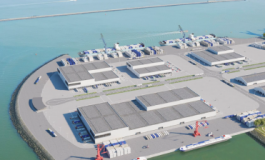
By Peter de Langen Rotterdam’s recent announcement that it is developing a 60-hectare ‘Food Hub’ at the entrance to Maasvlakte is interesting, both because of the concept and of the history of the site The industrial site will be developed to offer optimal facilities for ‘agrofood’ companies and will have multiple berths for container vessels and inland vessels, with special facilities for refrigerated cargo. The idea is that containers arriving at the Maasvlakte container terminals will move by ship to the food hub, while...
June 13th, 2019
Featured

Going beyond the usual approach of measuring port performance – focusing on the efficiency of port operations – the latest port study of PortEconomics member George Vaggelas, aims to look into shipping lines and other port users’ perceptions on port performance. The study develops a framework measuring the perceptions of port users (i.e. shipping companies, shippers, etc.) on port performance. A typology of elements that shape port users’ perceptions has been developed with an eye on capturing the peculiarities of different port...
June 3rd, 2019
Featured

The characteristics and the role of the European ports in a new world was titled the presenation delivered by PortEconomics member Theo Notteboom during the 16th ESPO Annual conference held in 23-24 May, in Livorno, Italy. Theo participated in the "New Ports" session, along with Cleopatra Doumbia-Henry (President of the World Maritime University) moderated by Matej Zakonjsek (Head of Cabinet of Commissioner Violeta Bulc). Theo, in his presentation described the new world and set a question "do we need port authorities?" Follow the...
May 27th, 2019
Featured

Celebrating the 2019 edition of Posidonia Sea Tourism Forum #PSTF2019, the major cruise event in East Med, PortEconomics.eu presents a PortVideo visualising the top20 cruise ports in the Med throughtout the period 2000-2018. The PortVideo was prepared by PortEconomics members Thanos Pallis, Aimilia Papachristou and George Vaggelas....
May 20th, 2019
Featured

Port management entities, -or, Port Authorities, in a most accustomed context are increasingly involved in collaborations with other ports, commercial entities and institutions. As Port Authorities (PAs) ‘go international’ via several strategies, they expand collaborations well beyond the notion of proximity. While they continue to be involved in various forms of collaboration with ports and other entities located in nearby proximate regions, they also seek to establish and benefit by relationships with geographically non-proximate ports...
May 16th, 2019
Featured

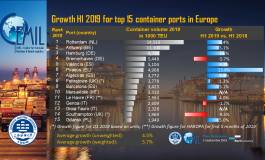
By Theo Notteboom The top 4 European container ports have remained unchanged since the start of containerization in Europe in the late 1960s: the Dutch port of Rotterdam, the Belgian port of Antwerp and the German ports of Hamburg and Bremerhaven have always occupied the top spots in TEU terms in the European container port system. These four ports are all located in the so-called Hamburg-Le Havre range in northwest Europe. Hamburg for a long time ranked second in Europe, but since the crisis year 2009 Antwerp successfully challenged...
Page 33 of 83...3132333435...