Featured

March 19th, 2019
Featured

The last two decades the structure, strategies, and operational frameworks of cruise ports changed in too many respects. Infrastructure renewal and construction has been accompanied by a wave of reform in cruise ports governance. Cruise ports management has matured with sophisticated strategies involving port professionals and linked port service providers and stakeholders. Operational practices have been reformed serving the changing features of the deployed (bigger) vessels and the modern cruise product. The reorganisations have in...
March 12th, 2019
Featured

By Peter de Langen At the end of 2018, the Danish municipality of Kolding, the owner of Port of Kolding and the landlord port development company, decided to shut down the commercial port with a transition period of 25 years. That deserves a WOW. It also begs questions: is this a bold visionary move to be applauded? Is it likely to be replicated elsewhere? Does it have repercussions for the way we think about the ownership of state-owned port companies? From a public policy perspective, the core question is whether or not closing...
March 8th, 2019
Featured

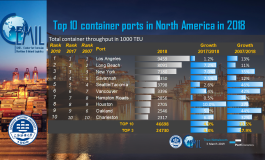
By Theo Notteboom The table provides an overview of the TEU throughput in 2018 in the top 10 container ports in North America and also shows the growth figures 2017/2018 and 2007/2018. The figures lead to the following conclusions. The top 10 ports in North America handled 47 million TEU in 2018 The top 10 ports in North America handled 47 million TEU in 2018 or +4.9% compared to 2017 and +23.5% compared to 2007. In comparison, these figures were +4.7% and +94.4% respectively for the top 10 container ports in mainland China (183...
March 6th, 2019
Featured

PortEconomics members Michaël Dooms, Larissa Van Der Lugt, Francesco Parola, Giovanni Satta, joined by Dong-Wook Song (World Maritime University) in their latest port study, published at the scientific journal Maritime Policy and Management, aimed to establish a framework being conceptually able to explain a variety of internationalization strategies and related activities employed by port managing bodies (PMBs), as defined by the European Sea Ports Organisation (ESPO) in 2018, considering their hybrid nature. Having identified a potential to...
March 2nd, 2019
Featured

By Theo Notteboom The cargo volume handled remains a key performance indicator for ports. While also other indicators related to logistics performance, sustainability, innovation and economic impact are gaining ground, it remains relevant to observe how cargo volumes have evolved over time. The table shows the top 15 container ports in the European Union in 2018 based on container throughput expressed in TEU. It also includes container growth figures compared to 2017 and pre-crisis year 2007. What do the figures reveal? Top 15: y-o-y...
February 28th, 2019
Featured

By Peter de Langen Lately, there has been much talk about the entry of new disruptors into ocean shipping, with Amazon most frequently referenced When ‘entry’ is understood as providing ocean freight services, this is now happening: Amazon is already handling shipment of goods by ocean for Chinese merchants that sell on Amazon’s site. In addition, Amazon has entered the market for delivery services for businesses, competing with the like of UPS and FedEx. It has not gone unnoted that Amazon owns and leases more than 40 cargo...
February 26th, 2019
Featured

By Theo Notteboom The table provides an overview of the total TEU throughput in 2018 of the top 10 container ports in mainland China (plus Hong Kong) and also shows the growth figures 2017/2018 and 2007/2018. The figures lead to the following conclusions. Shanghai remains the no. 1 container port in mainland China and the world The top 10 ports in China handled 183 million TEU in 2018 or +4.7% compared to 2017. Shanghai in the Yangtze River Delta remains the undisputed no. 1 container port in mainland China and the world with over 42...
February 19th, 2019
Featured

Automation is bringing a series of paradoxes to the shipping industry. Since maritime shipping is in the derived demand business, it is misleading to assume that automation does not affect the demand for shipping as well. Although automation is mostly considered by the industry at the port terminal level, it also takes place across entire supply chains, a process associated with the fourth industrial revolution (manufacturing 4.0/4IR). The impacts of automation may thus be more significant on the activities that drive port volumes, such as...
February 14th, 2019
Featured

The construction of an interoceanic canal in Nicaragua, a longstanding controversy, has once again become a source of concern in recent years, in both the global shipping industry and the world at large. Since the canal was green-lighted by the Nicaraguan government, scientists and specialists have sharply criticized its potential to inflict lasting environmental and societal damage. The vocal doubts raised by many experts regarding the canal’s feasibility have resulted in several recent postponements of construction. Studies of the...
February 7th, 2019
Featured

Genova - In the Port 4.0, that runs towards the automation of as many activities as possible, the work on the dock is not destined to become extinct, but rather to evolve. A path that however can not pass only through the transformation of processes, but rather from the training of workers. George Vaggelas, professor at the University of the Aegean and a partner of P & S Advisory, a consulting firm for some big port terminals, such as COSCO and DP World, is convinced of this. Which are, in short, the skills that the docker of the future...
Page 35 of 83...3334353637...