Featured

February 28th, 2018
Featured

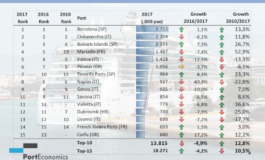
By Theo Notteboom The cargo volume handled remains a key performance indicator for ports. While also other indicators related to logistics performance, sustainability, innovation and economic impact are gaining ground, it remains relevant to observe how cargo volumes have evolved over time. The table shows the top 15 container ports in the European Union in 2017 based on container throughput expressed in TEU. It also includes container growth figures compared to 2016 and pre-crisis year 2007. What do the figures reveal? Top 15:...
February 21st, 2018
Featured

Ports are an important economic actor—at local, national, and international scales- that have been identified as being vulnerable to future changes to the climate. The latest port study of PortEconomics co-authored by Adolf K.Y. Ng along with Austin Becker (University of Rhode Island and University of Manitoba), Darryn McEvoy (RMIT University) and Jane Mullett (RMIT University) details the findings from an international review of state‐of‐the‐art knowledge concerning climate risks, and adaptation responses, for ports and their...
February 18th, 2018
Featured

By Theo Notteboom Last week, the Rotterdam Port Authority presented the port’s cargo throughput figures for 2017. With a 10.9% y-o-y growth, the Dutch port handled 13.73 million TEU in 2017. The strong results in 2017 reinforced Rotterdam’s position as the largest European container port, followed by Antwerp (10.45 million in 2017, a growth of 4.1%), Hamburg (8.82 million TEU, -1%), Bremerhaven (5.54 million TEU, +0.9%) and Valencia (4.83 Million TEU, +2.3%). With a 10.9% y-o-y growth, the Dutch port handled 13.73 million TEU in...
February 12th, 2018
Featured

The innovative solutions for a sustainable network  in the Med and beyond was the key theme of PortEconomics Francesco Parola presentation delivered during the opening session of the MEDPorts forum  held in Marseille, France. Francesco discussed the “success” of ports & logistics chains and how can be measured, the economic, environmental and social bottom line, while he shared some insights on the sources of success. The full presentation can be freely downloaded via PortEconomics here....
January 31st, 2018
Featured

By Peter de Langen The inevitable is likely to happen to the Red Hook Container Terminal in Brooklyn, New York After decades of policy to keep the terminal open to ensure that Brooklyn continues to have a blue collar ‘working waterfront’, the only container terminal in the state of New York may finally close down and give way to the development of urban functions. The state governor Andrew Cuomo has suggested a “more productive community use” for the approximately 80 acres of waterfront land. Even though the announcement...
January 22nd, 2018
Featured

In which ways the changing organizational routines of shipping (i.e., alliance formation and vertical integration in container terminal operations) are affecting the selection of ports of call in intercontinental liner service networks? The latest port study by PortEconomics members Theo Notteboom, Francesco Parola, Giovanni Satta and Thanos Pallis analyses the relationship between port choice and terminal involvement of alliance members in container shipping. The study examines the relationship between port choice of alliance...
January 16th, 2018
Featured

Α just published research reveals the leading role of several members of PortEconomics team in maritime research in the 21st century. Reviewing the top 50 authors in maritime research over the period 2000-2015, Chang, Y-T., Choi, K-S., Jo, A. and Park, H. published in early 2018 a study of the ‘Top 50 authors, affiliations, and countries in maritime research’, ranking scholars as regards the number of papers; the weighted score according to their contribution in the respective studies; and the impact of their research based on...
January 15th, 2018
Featured

By Peter de Langen In November, Associated British Ports (ABP), the UK’s leading port operator, launched its transformed property arm with a 960-hectare land bank, marking a further step in the gradual transition of the group from port operator to a development company of port, logistics and manufacturing complexes in 21 UK ports, writes Peter de Langen. ABP owns around 5,000 hectares of land, of which around 900 hectares is available for development. In its 2017 first half year trading update, ABP noted that it aims to build a...
January 12th, 2018
Featured

The construction of an interoceanic canal in Nicaragua is a longstanding controversy that goes back to the late 19th century when the US had plans to construct the canal but in the end decided to develop the Panama Canal instead. The plans for the construction of the Nicaragua Canal have resurfaced in recent years. In September 2012, a newly formed private Chinese enterprise, the Hong Kong Nicaragua Canal Development Group (HKND), proposed a five-year construction plan at a cost of 50 billion U.S. dollars and signed a memorandum of...
January 6th, 2018
Featured

The succession of maritime accidents in the last decades of the 20 century caused a strong political and public outcry for more stringent maritime safety regulations and measures. One of the most significant developments in this regard was the establishment of several regional agreements on Port State Control (PSC) – the first of which was the Paris MoU – with the specific objective of fighting substandard shipping through coordinated and harmonised inspection procedures. PortEconomics member Pierre Cariou along with Armando...
Page 43 of 82...4142434445...