Featured

November 7th, 2017
Featured

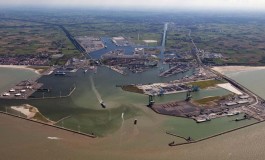
By Peter de Langen This year saw positive news for the two large new port development projects in North West Europe: JadeWeserPort and London Gateway Both ports, sometimes cited as unsuccessful port development projects, are on a slower development path than initially foreseen but now seem to have developed the critical mass for further growth. And they have managed to grow in complicated market environments. This is in sharp contrast to a previous ‘newcomer’, Zeebrugge, that also managed to attract substantial volumes - over...
November 3rd, 2017
Featured

Port management is one of the most important economic pillars in maritime countries, where business players – such as port authorities, shippers, carriers, terminals, etc. - are called to undertake a virtuous process of economic development, respectful of the environment. This means achieving a sustainable growth, supported by green actions for environmental protection to improve corporate social responsibility. PortEconomics member Francesco Parola - along with Marcello Risitano, Alessandra Turi and Marco Ferretti (University of Naples...
October 26th, 2017
Featured

A review of seven large landlord port authorities around the world reveals a notable diversity of pricing structures. While port authorities increasingly act as commercial undertakings, port pricing often seems not driven by commercial considerations. In the latest port study PortEconomics co-director Peter de Langen along with Roy Van Den Berg (Port of Rotterdam Authority, The Netherlands) and Paul C.J. Van Zuijlen (Broekman Group, The Netherlands) argue that ports can be regarded as ‘business ecosystems’ with multiple users. This...
October 26th, 2017
Featured

UNCTAD published today the 2017 edition of Review of Maritime Transport, a recurrent publication prepared by the UNCTAD secretariat since 1968 with the aim of fostering the transparency of maritime markets and analysing relevant developments. The Review of Maritime Transport 2017 presents key developments in the world economy and international trade and related impacts on shipping demand and supply, and freight and charter markets in 2016 and early 2017, as well as seaports and the regulatory and legal framework. In Chapter 4, Review of...
October 23rd, 2017
Featured

Most countries are reluctant to entirely privatize their port authorities, making port corporatization the model of choice. Today, the most commonly pursued route for port governance reform embraces the concept of an autonomous, government-owned port authority with terminal operations under private companies. Many countries fall short of fully e ective corporatization of their port authorities, however, because they retain some administrative and decision-making mechanisms under government control. PortEconomics co-director Peter de...
September 21st, 2017
Featured

The PORTOPIA partners - including several PortEconomics members - are happy to present the outcome of the project and to shed a light on future developments during the Final Event that will take place on November 9, 2017 in the BNP Paribas Fortis Auditorium Marais in Brussels (Belgium). This event must be seen as a milestone in the data digitalisation agenda of the European port sector. Within the framework of the PORTOPIA project, a European consortium of academics, IT experts and port professionals has been working for four years on the...
September 13th, 2017
Featured

By Peter de Langen Port development often has an important geopolitical dimension This dimension came to the fore recently with the news of the new agreement struck between China Merchants Port Holdings Company and the government of Sri Lanka on the Hambantota port development project in a remote part of Sri Lanka. The project was financed with a Chinese government loan, but so far has not attracted sufficient business to be profitable. This was not completely unexpected: the local cargo base is very small and thus the business...
September 8th, 2017
Featured

By Theo Notteboom The table shows the top 15 container ports in the European Union in 2016 based on container throughput expressed in TEU and the year-on-year growth in H1 2017 (for some ports Q1 2017). No figures were available for Marsaxlokk. What do the figures reveal? With an overall growth figure of 3.7%, the top 15 ports are performing much better than in 2016 First, with an overall growth figure of 3.7%, the top 15 ports are performing much better than in 2016 (+2.1%) and 2015 (-1.6%). The top three recorded a...
August 28th, 2017
Featured

Download PortReport No 2- Caribbean container port catchment areas: 1998-2016 evolution and the risk of over-investment Almost from its inception, there has been a clear upward trend in the disruptive force of the container during its use. However, a relative decrease in container movement has been seen in recent years although the explanation of which goes beyond disturbances in the world economy. PortEconomics member Ricardo Sanchez along with Eliana Barleta notice that the inter-annual change in throughput with respect to changes in GDP...
August 28th, 2017
Featured

In 1992, UNCTAD outlined a three-generation model to classify different stages that the port industry has experienced. It illustrates that port evolution is not a linear progress but periodically with key events to re-start every stage. An important research question emerges on whether the port industry has involved to the new generation or not after more than two decades of development. To provide useful insight into this research question, PortEconomics member Adolf Ng along with Kennth H. Wong (Hutchison Port Holdings, Hong Kong,...
Page 45 of 82...4344454647...