Featured

March 9th, 2021
Featured

While large dry ports with high throughput are more likely to have onsite rail access, the question is more difficult for small and medium sites, which may not have sufficient throughput for rail viability. Thus whether a new dry port development should be located with or without direct rail access is a major concern at the proposal stage. This challenge is a current concern in many developing countries experiencing a surge in dry port demand. The aim of the latest port study by PortEconomics member Jason Monios along withYuhong Wang,...
March 5th, 2021
Featured

The latest portstudy by PortEconomics member Michael Dooms along with Bruno Moeremans (Vrije Universiteit Brussel), develops exploratory research to improve the understanding of actual practices applied in the port industry relating to local communities’ perception measurement and public engagement, aiming at maintaining and fostering relationships with local communities. The application of such practices would allow port managing bodies to improve their strategic alignment with the needs and requirements of their local communities. To...
March 2nd, 2021
Featured

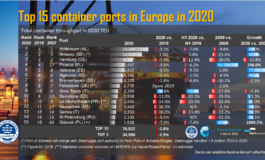
by Theo Notteboom Port performance measurement covers a wide array of key performance indicators (KPIs) related to supply chain performance, productivity, connectivity, sustainability/energy transition, corporate social responsibility (CSR), financial performance, customer satisfaction, innovation and economic impact. Still, it remains relevant to observe how cargo volumes have evolved over time, as cargo flows and related activities remain the bread and butter of port authorities and terminal operators. The table shows the 2020 container...
March 1st, 2021
Featured

Download GREPORT 2020 here GREPORT2020, the third edition of the biannual report on Greek ports is now available to be freely downloaded via PortEconomics. The report contains sections on Latest developments in Greek port policyCargo throughput trendsPassenger movementsFinancial standing of Greek portsDevelopments per port The third edition of the flagship report for Greek ports contains an additional section "Focus" containing a review of the impacts of the COVID-19 pandemic on the Greek port system and the evolution of Greek...
February 27th, 2021
Featured

About two weeks ago, the port authorities of Antwerp and Zeebrugge in Belgium announced they are starting the process towards a full merger. The new merged entity will bear the name "Port of Antwerp-Bruges". Theo Nottteboom, PortEconomics co-director, comments "While the transition to a low-carbon port is high on the agenda, the merger will also create a large container port complex combining the large upstream facilities of Antwerp with coastal container terminals in Zeebrugge. Combined these terminals handled about 13.8 million TEU...
February 23rd, 2021
Featured

By Peter de Langen The French Haropa ports, Le Havre, Rouen and Paris are steadily implementing the full merger announced over two years ago; the final step should be ready June this year. As an important part of the integration, they recently published a strategic plan until 2025.  The plan is an interesting read and clearly reflects the changed landscape in the port industry. While in 2015, Le Havre had the ambition to grow container volumes with 50%, to around 4.8 million, this plan aims for a much more modest growth of 10%, to...
February 21st, 2021
Featured

Number of ports experiencing some delays in cross-border trucking services, with rail and barge delays increasing noticeably. The results of the sixteenth survey of global ports have been published in the WPSP- IAPH COVID19 Port Economic Impact Barometer today, with an even spread of 70 participants worldwide. The share of ports facing a significant drop in container vessels calls (i.e. in excess of 25%) dropped further to 2% . Some three quarters of ports are reporting that vessel calls are similar or even higher compared to the same...
February 15th, 2021
Featured

The latest portstudy of PortEconomics member Jason Monios co-authored by Rickard Bergqvist explores influences on migration of hub status in an intermodal network from a port to an inland node by following the life cycle of inland terminal development. The methodology is a longitudinal case study of the Swedish intermodal system over a period of 20 years, based on documentation, interviews, and action research. The authors observe the changing roles of the Port of Gothenburg and the Falköping terminal at different time periods. These...
February 8th, 2021
Featured

PortEconomics member Pierre Cariou participated as a guest speaker at the 2021 World of Shipping Portugal Conference, which was held online 28-29 January 2021. Pierre gave a most interesting presentation on Liner shipping, containerization, and mega carriers. What structural changes to be faced by the industry operators? discussing how the structural change in demand, resulted in structural adjustment for carriers and what are the future changes. Follow the link to download Pierre's presentation. ...
January 26th, 2021
Featured

Container shipping is the largest producer of emissions within the maritime shipping industry. Hence, measures have been designed and implemented to reduce ship emission levels. IMO’s MARPOL Annex VI, with its future plan of applying Tier III requirements, the Energy Efficiency Design Index for new ships, and the Ship Energy Efficiency Management Plan for all ships. To assist policy formulation and follow-up, this port study applies an energy consumption approach to estimate container ship emissions. The volumes of sulphur oxide...
Page 20 of 83...1819202122...